Showing posts with label books. Show all posts

Thursday, August 02, 2007

A Proud Tradition

For those of you who thought my last post was a little overly critical, let me just qualify that observation by saying that a) the critique is by no means restricted to Americans, or even westerners, as we all have our comparatively frivolous obsessions all over the world - and b) I wasn't the only one who pointed this comparison out. CNN spent Harry Potter Day talking about both the lines at bookstores and the lines at Iraqi gas stations in such a pointed fashion that I assume the producers there are not incapable of recognizing parallels.

Waiting for books is actually a proud American tradition - one that I have no interest in participating in or disparaging in and of itself. Legend has it that American fans of Charles Dickens would wait on the docks of New York harbor for the ships bearing each edition of Master Humphrey's Clock in hopes of hearing the deckhands shout out the fate of poor little Nell (SPOILER ALERT: She dies). Or so it has been described to me by a fellow purporting to be both my father and Very Knowledgeable in These Things™.

Sunday, September 18, 2005

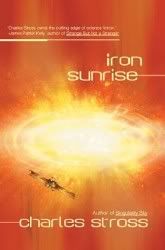
Notes: Iron Sunrise

Image hosted by Photobucket.com

The work of Charles Stross fell into my lap unexpectedly last year. Jason gave me a blind recommendation of Singularity Sky over the phone while I was searching the local Borders for a book to read on a plane. Happily, that exchange also netted a copy of Vernor Vinge's A Fire Upon the Deep. Both excellent reads - really the sort of Slipstream meets New Weird births Infernokrusher eats your head kind of stories I had been looking for. Unfortunately, the shine has come off the further works of these two authors - they seem to fall a little flat.

I could do a whole post on Vinge's crap-out in Deepness in the Sky but the only thing worthy of note here is that the flaws in that book closely echo those of Iron Sunrise. Stross and Vinge were drinking buddies, so I guess that makes sense.

The key problem with Iron Sunrise is that it reads like a studio-scripted sequel. It has all the style and flavor of the first book, but no strong plot of it's own. Stross falls back on what were once delicious details of the bizarre post-singularity universe but are now stale reiterations. Recurring characters are static and uninteresting, prone to moments of "my God, we're doomed" realizations and long dramatic pauses. The villains are comically villainous and pointlessly perverse. The new characters are inconsistent in their personalities and rarely distinct from the "fuck everything, I'm a good guy everywoman action hero" attitude that pervades the book's dialogue.

The story is your basic save the universe tale, complete with Nazis. There's a bit of spaceship blueprint porn, some explosions, some sex, some Warren Ellis style shock perversity, and various explorations of the essence of the Singularity trope. Characters explain how the sciencey things work and snub their futuristic populist noses at the rich and ignorant. Then cap the whole thing off with a terribly amateur cliffhanger ending - equivalent to one where the seemingly dead villain jerks back to life long enough to take a potshot at the hero - and you're done.

This is the most phoned-in book I've ever read. Not only that, it was phoned in to the editor's angry spiteful messaging service. I may still pick up Accelerando, in the hopes that Stross zipped past this one to get to the book he REALLY wanted to write, but this outing leaves a lot to be desired.

Tuesday, June 07, 2005

Bookin'

This was not passed to me, but I'm going to do it anyway as an act of defiance. I'm not sure what it is I'm defying, but it should consider itself defied, dammit.

Total number of books owned:
Roughly 250. Does not include comics, copies of National Geographic, or video game manuals. I have one of the largest and most diverse collection of mint condition game manuals ever assembled. Atari, Nintendo, PC, Saturn, Dreamcast. I got it all, baby. Who want to see the secret notebook of Willy Beamish? Come on in. To be fair, maybe I shouldn't count the books I will likely never get around to reading, like the film theory books from college or the 6 Robert Jordan books I'd just as soon line the birdcage with, but in this case I'll pull a Gatsby and pad the library a little.

Last book bought:
Jonathan Strange & Mr. Norrell: A Novel by Susanna Clarke. This is an 800 page book heavy enough to stun a burglar. It is about the lost art of English magic in, well, let's call it Victorian London, since I'm too lazy to go confirm or refute that. It is very dry and very British and quite good.

Last book read:
On Bullshit by Harry G. Frankfurt. A wonderful pamphlet from a Princeton professor, recently re-released (the pamphlet, not the professor), on the nature of bullshit. It's above-par academic wanking, in that you're actually left with useful information at the end, rather than pointless phrases like "hypermodernism." The central argument is that bullshit is more than just lying, it is a casual disregard for the truth, an amoral dismissal of moral imperatives. There are some profound points about politics and public discourse throughout, so it's definitely worth the short read.

Five books that mean a lot to you:

Fahrenheit 451 by Ray Bradbury. I recently re-read this and was surprised to find I had forgotten how much I loved it. Often mis-quoted to describe a world of totalitarian government censorship, it's actually about the voluntary self-censorship of an intellectually stunted society. A harsh lesson about political correctness and willful apathy. Bradbury has several short stories that deal with these themes, but of course this is the classic.

Catch-22 by Joseph Heller. I think I got more academic mileage out of this novel than anything else I've ever read. It is a dense, wonderfully complex story told in a bizarre, absurdist format, and it's hilarious and horrifying at the same time.

The Hitchhiker's Guide to the Galaxy by Douglas Adams. Talk about absurdist. I read one of the Hitchhiker's books at least once a year. Still haven't seen the movie yet.

Snow Crash by Neal Stephenson. This is simply a great sci-fi adventure, simultaneously celebrating and defying the tropes of the cyberpunk genre all over the map. In a lot of ways Snow Crash seems like the logical predecessor to the current singularity fiction from Charles Stross and Vernor Vinge. Stephenson has an inventive approach to everything he has written, but unfortunately Cryptonomicon was so nerd niche that I couldn't get past the third chapter.

Snow Crash inches out Peter Watts' Starfish by the slimmest of margins.

Ender's Game by Orson Scott Card. Virtually every Geek of a Certain Age has read and loved this book. Card has said as much in the foreword to his Ender's Shadow series - stories about children often untimately appeal to children. This was a great read to an awkward middle school kid, and it's just as fun to the awkward, geeky adult.

Tag five people to continue this meme:
Unlikely respondents, but what the hey.
Dave
Jill
Katie
Marc
Rob

Thursday, April 21, 2005

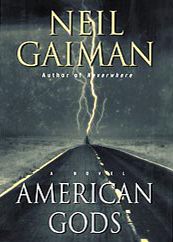
Notes: American Gods

Image hosted by Photobucket.com

Neil Gaiman's prose is like candy for liberal arts majors. On the surface, it's a wonderfully-composed chocolate adventure shell, interesting in itself and contemporary enough to still be warm and gooey. Inside each chapter, you find a random tasty filling. Sometimes its an old favorite - like mythic Celtic fudge or sweet vanilla Valhalla. And sometimes it's something new and exotic, like deep African spider raspberries, mint Russian house elves or Aztec stone coffee heads. The best part is, it's not bad for you at all. But in the end, you can only eat so much candy in one sitting.

As you can see, I've just finished American Gods. It was entertaining, but it never became more than a laundry day book for me, even when I was salivating over the latest obscure reference or clever twist. I think it's because it frayed very easily at the edges, story-wise. Gaiman lays down some serious world-building rules in the first half of the book that he ultimately violates or ignores by the second half.

The story centers around Shadow, a sort of lost spiritual everyman, fresh out of prison, as he is thrust into a deeply chaotic battle between the old gods of centuries past (Odin, Horus, Coyote, etc.) and the new gods of the modern age (Media, Town, Stone, err... World... fat Internet kid.... huh?). The problem with the set up is that he seems to set some very firm guidelines for how the old gods behave in the modern age, but he takes a mulligan on the actual modern gods. Some are distinct, some are vague, some have minions, some don't. It's very hard to pin down exactly what they represent or why they exist. And Gaiman really dodges the whole Christ thing. One passing reference to how easy that kid had it and a handful of swears and that's about it. No recognizable Buddhism either.

So the story flies apart near the end in a very unsatisfying way. Certain revelations about the nature of the plot and universe are easily anticipated, and therefore less interesting, while others are tangental to the plot and therefore confusing. Ultimately we end on an awkward rising action that reveals more and more fantastic things until they stop being fantastic and become boring. I wish Gaiman had stopped writing around page 484. You know, when the main character SPOILER SPOILER SPOILER dies. There are 104 pages after that and they really don't add much. Kinda like the last fifteen minutes of the Hulk when Bruce Banner fights the lake.

Wow, I just remembered that Shadow actually has a scene like that in the last chapter. Weird.

The worst part is, the book made me think about death in a very personal, philosophical way, and now I can't stop contmplating the great beyond. It's not fun. Damn your thoughtful esoteric heart, Neil Gaiman!

So anyway. Tasty treat if you like that sort of thing. Good sugar rush. Lots of brushing and excercise required afterwards.